
Master Chief Petty Officer Julian Trent
Name Julian Trent
Position Chief of the Boat
Second Position Tactical Officer
Rank Master Chief Petty Officer
Character Information
| Gender | Male | |
| Species | Human | |
| Age | 51 |
Physical Appearance
| Height | 6' | |
| Weight | 178lbs | |
| Hair Color | Ash brown with grey at the temples | |
| Eye Color | Blue | |
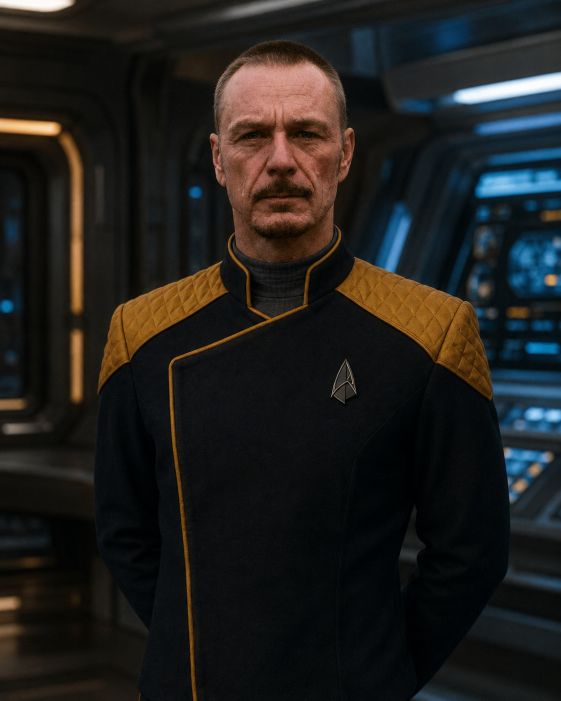
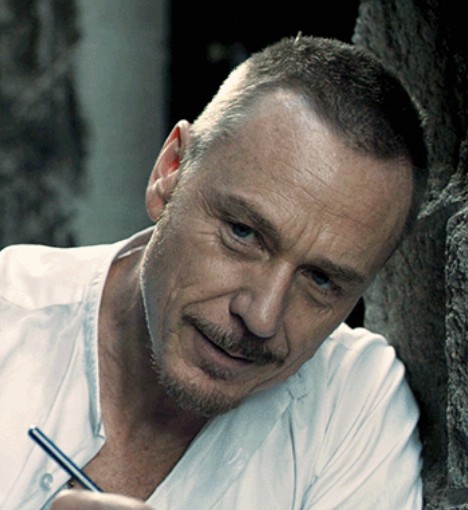
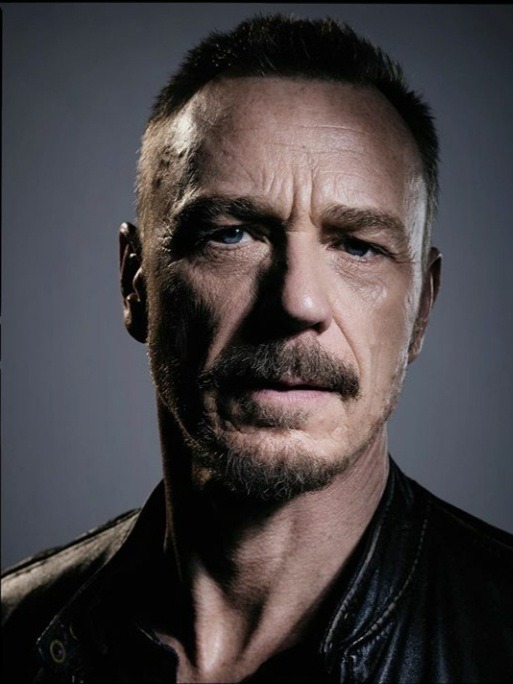
| Physical Description | Julian Trent is a tall, lean human man with the sort of strength that comes from decades of service rather than time spent trying to look good. He is not broad, but he is wiry and fit, with long limbs, defined muscle and a controlled way of moving. He has a narrow, angular face, sharp cheekbones, a strong jaw and lines around his eyes and mouth that make him look as if he is either concentrating or about to say something he really shouldn’t. His eyes are a clear, pale blue and often difficult to read. There is warmth there, but he does not always let it reach the rest of his face. His hair is ash brown, kept short and practical, with grey at the temples and through the sides. He usually keeps some facial hair, trimmed enough to look intentional, but still rough enough to suit him. Years of service have left marks on him. He has old scars from shipboard combat and wartime injuries, though the worst of the damage is internal and written into his medical file rather than obvious at a glance. His biomechanical cardiac implant leaves no visible sign unless he chooses to mention it, which he usually does with the sort of dry humour that makes people unsure if they are allowed to laugh. In uniform, Trent looks like exactly what he is, a senior enlisted man who has been around long enough to know when things are about to go wrong. |
Family
Personality & Traits
| General Overview | Julian Trent is intelligent, restless and more disciplined than he used to be. In his youth he chased sensation, company and trouble because he was bored, lonely and looking for something that made him feel wanted for more than a moment. He drank, gambled, flirted, argued, took lovers and tried on philosophies and pleasures with the same appetite, usually until they stopped being interesting. Starfleet did not make him into a different person, but it gave him work, consequence and something useful to do with his mind. On duty, Trent is sharp and very capable. He has a natural tactical mind and works well when there is pressure, risk and a clear outcome. He has little patience for posturing or incompetence, especially from people who should know better, but he is not cruel with junior crew. He can be hard on them, and sometimes blunt, but usually because he is trying to make sure they know what they are doing before things get dangerous. Off duty, Julian can be charming, playful and flirtatious when he feels like it. He has a dry wit and knows how to use his accent when it suits him. He is not warm in an easy, open way, but he is not cold either. He does make friends and he does form bonds, though not as easily as people might expect from someone who can seem so socially confident. He cares about people more than he tends to admit, which is probably part of why he keeps most of them at a safe distance. When Jules loves, he does not do it lightly. Nico Canto softened him because Nico gave him affection without making it feel like a performance or a trap. Jules loved him with the certainty of a man who had finally found something he did not grow bored of or want to run from. Nico’s death changed him, but it did not make him empty. He still drinks more than he should at times, still uses humour when something hurts too much to talk about properly and still carries grief as part of his life rather than something he expects to put down. Julian is capable of tenderness, desire, loyalty and real affection, but he is also capable of putting the ship above one person when duty requires it. That is not because he cares less, but because he understands consequence. He has had relationships since Nico, and can still want, flirt and care, but he does not pretend that grief left him untouched. Trent is a survivor, a senior enlisted man, a lover, a cynic and, when it counts, a deeply caring bastard. He does not believe much in clean new beginnings, but he does believe in showing up, doing the work and keeping people alive if he can. |
|
| Strengths & Weaknesses | Strengths: * Julian has a strong tactical mind, especially under pressure. He can read a situation quickly, calculate risk and act before others have caught up. * He is calm in a crisis and difficult to rattle, with decades of shipboard service and wartime experience behind him. * As a Master Chief, Trent is an effective trainer of junior enlisted crew. He is demanding, but not cruel, and teaches habits that keep people alive. * He cares deeply, even when he does not show it softly. His care comes through in preparation, discipline, correction and quiet attention to detail. * Julian is charming when he chooses to be, with a dry wit, flirtatious edge and enough social confidence to work a room when needed. Weaknesses: * Jules can be emotionally guarded and slow to let people close, even when he likes them. * His grief over Nico remains unresolved, not in a way that stops him living, but in a way that never fully leaves him. * He can drink more than is wise when old memories become too sharp or sleep becomes difficult. * Trent has limited patience for posturing, incompetence or people in authority who put others at risk. * He has a habit of putting duty, the ship and others before himself, sometimes to a dangerous degree. |
|
| Hobbies & Interests | Julian enjoys games of chance and strategy, although he is more careful with gambling now than he was in his younger years. He still enjoys cards, dice and anything that lets him read people as much as the odds, but he keeps it controlled enough not to end up in official reports anymore. He reads a great deal, and always has. His interests are broad rather than fashionable, ranging from Earth classics to philosophy, comparative religion, ethics and old political texts. Some of this started as youthful experimentation, chasing meaning from one idea to the next, but the habit stayed with him long after the certainty faded. Jules enjoys tactical simulations, both to keep himself sharp and because he genuinely likes the challenge. He prefers scenarios with limited resources, damaged systems or no clean answer, finding perfect conditions too unrealistic to be interesting. He likes music, especially older Earth rock and folk, usually the kind with rough edges, strong voices and lyrics that have survived a few bruises. He tends to listen alone, though he is not above making dry comments about other people’s taste if invited. Julian is also fond of good conversation when he can find it, especially with people who can keep up with him, challenge him or make him laugh without trying too hard. He enjoys flirtation, wit and verbal sparring, though he is more selective with it now than he was when he was younger. |
| Personal History | Julian Trent was born on Earth in 2338 and became a ward of the Federation when he was still young enough that he had very little memory of belonging to anyone else. His name was one of the only things his birth parents left him, though he never knew if Julian Trent was a family name, a gift, or just the name they had written down before handing him over. There was no great cruelty in his upbringing and no dramatic event he could point to later and blame everything on. He was housed, fed, educated and looked after by people who were kind enough and professional enough, but none of them stayed. It gave him stability on paper, but not much in the way of warmth. As a child, Julian learned quickly that being easy was better than being needy. Adults liked him more when he did not ask for too much, so he became clever, observant and good at knowing when not to speak. By the time he was a teenager, that need for warmth had started to come out in other ways. He looked for affection through friendships, relationships, sex and anything else that made him feel wanted for a while. He drifted through philosophies, religions, parties, drugs, alcohol and synthol with the same sort of restless curiosity, but none of it ever kept his attention for long. By his early twenties, Julian had become very good at enjoying himself and very poor at being satisfied. He had freedom, safety and all the support the Federation could offer, but no real direction. It was not shame that made him change, or fear, or some sudden moral awakening. It was boredom. He realised that he could keep doing the same thing for another ten years and the universe would probably let him. So, at 22, and still hungover from the night before, he enlisted in Starfleet. It was not noble, and he never pretended that it was. He stayed drunk for most of the week before he was due to report, but when the day came, he reported. During enlisted training, Trent was put through the usual aptitude tests and evaluations. He was intelligent, although not always in the way exam papers liked. The sciences were his weakest area, mostly because he struggled to care about theory unless there was something practical attached to it. Tactical work was different. Give him pressure, limits and a clear outcome and he focused. He had a good sense for angles, timing, weapons load, shield stress and positioning. He was trained in both Security and Tactical, as plenty of ships treated the two as closely linked, but Tactical suited him better. He could calculate firing solutions under pressure and, with training, manually programme torpedoes from a tactical station with minimal computer assistance. It surprised him more than he admitted. His first posting came in 2361, when Trent was assigned to the USS Ganymede as a Tactical crewman. The work suited him, especially live drills, weapons calibration and anything that required him to think quickly, but shipboard life was not always smooth. He was not openly insubordinate, but he had a gift for getting himself and others into bad ideas, especially where gambling, drinking or shore leave were concerned. In 2364, he transferred to the USS Coventry, where his reports were promising but mixed. He was good at his job, calm in drills and quick under pressure, but he was also reprimanded twice for gambling and once for running an unauthorised betting pool on a junior officer’s command certification. In 2367, he was posted to the USS Tanagra, not long before the Borg attack at Wolf 359. Trent had barely been aboard long enough to know the ship properly before she was pulled into the battle. The Tanagra didn't explode, but was damaged so badly that the surviving crew were evacuated off rather than trying to repair it. It was the first time he saw a starship become a grave around people who had trusted its walls. After that, he was reassigned to the USS Argyll. The worst of his flippancy had been knocked out of him by then, though not enough to make him easy. He still had a sharp tongue and a weakness for gambling when bored, but he worked harder, paid more attention to junior crew and became less willing to treat danger as entertainment. In 2370, Trent transferred to the USS Murmansk, a Galaxy-class ship with a combined Security and Tactical department. It was there that he met Nico Canto, an enlisted medical technician with broad shoulders, warm hands and a sense of humour sharp enough to get under his skin. Nico was not impressed by Julian’s cynicism, which was part of the problem and, eventually, part of the attraction. Their relationship did not begin neatly. At first Nico was someone Julian flirted with because flirting was easier than being honest. Then he became someone Julian looked for in crowded rooms. Then he became the person whose opinion mattered, even when it irritated him. Nico had a way of making affection feel ordinary rather than dramatic, and over time that changed him. Jules still had his vices, arrogance and sharp tongue, but the worst of the recklessness eased out of him. There was no ring bought and no formal proposal, but by the time the Dominion War began he knew Nico was the man he intended to grow old with. It was not a grand romantic declaration. It was simply something he had come to understand about his own life. When the Dominion War began, the Murmansk was pulled quickly into the fighting. As a Galaxy-class ship, she was large, durable and too useful to be spared, so she became whatever was needed at the time. Warship, rescue vessel, mobile hospital, evacuation platform. Resupply became unreliable, repairs were improvised and civilian spaces were converted into triage, overflow bunks and storage. They often moved from one crisis to the next without much time to breathe. Tactical work stopped being something Trent was good at and became something people survived because he was good at it. Nico died during an attack on the Murmansk, in the middle of a casualty response. He had gone into a damaged section to help someone who was injured and unable to move when a secondary explosion tore through the corridor and breached the hull. The section vented before the emergency forcefields fully stabilised, taking Nico and several others with it. By the time the breach was sealed, there was no body to recover. No final conversation, no hand to hold and no face to remember at rest. Just the casualty report, the sealed corridor and the knowledge that Nico had died trying to save someone else. After Nico’s death, Jules became harder to stop. He did not fall apart in any obvious way, which made it easier for people to miss what had changed. He reported for duty, kept his station and remained useful, but the caution Nico had taught into him wore thin. He volunteered for away teams, boarding actions and damage-control details with a steadiness that looked like bravery unless someone knew him well enough to see what was underneath it. He was not careless with other people’s lives. If anything, he became more protective of junior crew. His own life, however, seemed to matter less. Near the end of the war, during one of the final actions involving the Murmansk, Trent was critically wounded by shrapnel during a breach and internal systems failure. The injury caused severe cardiac damage and he was transferred back to Earth for surgical reconstruction. He later joked, with the sort of dry humour that made medical staff stop smiling, that the heart had been damaged before the shrapnel got there. His damaged heart was replaced with a biomechanical cardiac implant, advanced enough to return him to service but significant enough to remain a permanent note on his medical record. After the war, Trent was not returned to the Murmansk. Once his recovery was complete, he was reassigned to the USS Norway, beginning a long period of post-war service that took him through recovery work, tactical readiness and senior enlisted responsibility. Peace did not come naturally to him. Julian drank more than he had before, not with the old reckless appetite of his youth but with a steadier and more private purpose. He was careful enough not to let it take his work from him, because Starfleet was all he had left. In service, Trent became sharper rather than worse. On the Norway, and later the USS Sussex and USS Osaka, he put more of himself into training younger enlisted crew. He taught weapons discipline, tactical station procedure, emergency calculations and all the small practical habits that made a difference when systems failed. He could be demanding, and sometimes severe, but he was not cruel. He had seen too many inexperienced people spent cheaply during the war, and he had no patience for anyone who confused fear with weakness. He rose through the enlisted ranks because people trusted him when things went wrong. Julian did not seem sentimental, and rarely spoke about what the war had taken from him, but he remembered people. He remembered who needed to be shown something rather than told, who worked better with a warning before a drill and who would only get annoyed if someone fussed over them. He noticed habits, preferences and little details that most people forgot, then adjusted without making a point of it. It made him good with junior crew, even if he was not always gentle with them. Socially, he remained guarded rather than closed. He was civil, dryly funny when he chose to be and not against companionship, but he stopped making himself easy to find. In 2384, Trent transferred to the USS Hastings. There, his tactical instincts, long service and ability to make quick decisions under pressure made him useful beyond training rooms and departmental work. He began taking more bridge duty, first as support and then as a regular Tactical presence. It was aboard the Hastings that he rose to the rank of Master Chief Petty Officer, becoming a senior enlisted anchor within Tactical. By 2388, his service record marked him as one of those rare enlisted specialists whose experience made him valuable at command level without needing a commission. Trent was transferred to the USS Guinevere as a Tactical Officer, bringing decades of shipboard experience, wartime survival and a reputation for seeing trouble before it fully arrived. He did not arrive looking for a new beginning. He had never trusted those. But the Guinevere offered work, structure and people who would need him, and that had always been enough to keep him moving. |
|
| Service Record | 2360-2361 – Starfleet Enlisted Training Programme, Crewman Recruit-Crewman Apprentice 2361-2364 – USS Ganymede, Tactical Crewman, Crewman 2364-2367 – USS Coventry, Tactical Specialist, Crewman-Petty Officer 3rd Class 2367 – USS Tanagra, Tactical Specialist, Petty Officer 3rd Class 2367-2370 – USS Argyll, Tactical Specialist, Petty Officer 3rd Class-Petty Officer 2nd Class 2370-2375 – USS Murmansk, Tactical Specialist, Petty Officer 2nd Class-Chief Petty Officer 2375-2378 – USS Norway, Tactical Specialist, Chief Petty Officer 2378-2381 – USS Sussex, Senior Tactical Specialist, Chief Petty Officer-Senior Chief Petty Officer 2381-2384 – USS Osaka, Senior Tactical Specialist, Senior Chief Petty Officer 2384-2388 – USS Hastings, Senior Tactical Specialist / Bridge Tactical Officer, Senior Chief Petty Officer-Master Chief Petty Officer 2388-Present – USS Guinevere, Chief of the Boat and Tactical Officer, Master Chief Petty Officer |